



















Borderline Personality Disorder Awareness Month: Discussing, Understanding & Publicizing an Under-Recognized Epidemic
May 5th, 2008 by Howard DitkoffThe End of a Borderline-Riddled Relationship
As described in my last blog post, “Choosing Intimate Partners: To Repeat or Not to Repeat?” I was recently involved in a challenging relationship that followed a familiar course. It began intensely, inspiring great hope for mutual healing and joy. However, gradually patterns emerged that I recognized from experience as typical of relationships involving a Borderline dynamic.
Because of my familiarity with conflicting relationship theories, I felt torn on how best to respond to these worrisome signs. Parts of me believed that the only healthy option was to disengage from the relationship – or more precisely, to resign myself to the growing awareness that my partner had already, for the most part, disengaged. Yet, other parts of me still held out hope that, in the manner of Imago Relationship Therapy, we could become more conscious of the archetypal dynamics involved, agree to reconcile, salvage the fragile but invaluable opportunity and harness the relationship’s conflicted energy toward growth.
However, shortly after writing that post, it came to my attention that the situation had long been, unbeknownst to me, even more complicated and dysfunctional than I had imagined. I had been deceived and misled in ways that, combined with many signs from throughout the course of the relationship, pointed rather convincingly to the conclusion that yet another potentially wonderful and nurturing partnership had been sabotaged by the tragic presence of Borderline Personality Disorder (BPD).
Revealing Conversations About an Under-Recognized Epidemic
In the painful aftermath of this realization, I spoke with many people who had experienced the shattering fallout of a relationship with someone suffering from BPD. The content of these conversations reinforced my confidence regarding my assessment of this relationship and refocused me yet again on the crucial role that this disorder plays in so many of our lives. The sheer numbers of people who shared their stories with me reinforced how prevalent BPD really is (I believe that it is far more widespread than typical estimates because those with BPD often fail to seek or remain in treatment and because they are often misdiagnosed, for example as Bipolar, due to clinician error, as well as to exploit more generous insurance coverage). Their heartwrenching tales dramatized the tremendous, and statistically disproportionate, emotional toll that the disorder takes on our society by way of all of us directly and indirectly affected by it.
I have gone so far as to say that Borderline, along with perhaps Narcissistic Personality Disorder (NPD), is the core disorder of our culture. In this assessment I seem to be in agreement with the eminent pioneer in the treatment of Personality Disorders, James F. Masterson, M.D., whose book, Search For The Real Self, focuses almost exclusively on these two disorders and, in its subtitle, identifies them as “The Personality Disorders Of Our Age.” I am also in agreement with Jerold J. Kreisman, M.D., author of I Hate You, Don’t Leave Me, who has declared ours “the Borderline society.” And yet, in far too many cases BPD – and NPD for that matter – remain shockingly unrecognized.
For example, the other day I received another reminder of just how elusive the recognition of Borderline Personality Disorder can be. I was speaking with someone with whom I had discussed BPD many times, including several times in the past few months, and who had heard a great deal about its presence in my recent relationship. This person was having great difficulty in a relationship of their own with someone close to them, describing it as an ordeal that had begun to take a toll on their self-esteem and frustrated them to the point of tears. As we talked about the specific course of the relationship, I pointed out that it was beginning to sound remarkably like a story of BPD.
Sure enough, as we looked over the symptoms of the disorder and the typical experience of the Non (the person who does not have BPD themselves but is in some form of relationship with someone that does), this person experienced the “light bulb effect.” They were extremely relieved that the baffling behavior of this acquaintance finally made sense. Yet I was taken by how this person, who had repeatedly heard about BPD from me in past weeks and months, still failed, as so many of us do, to recognize it even when faced with it directly.
Every day in our society, millions similarly fail to recognize the insidious and often devastating effects of BPD in friends, lovers, family members, co-workers, and, of course, in themselves. Given the central role of this disorder in our culture, the impact of its under-recognition and under-treatment on both BPD’s and Nons, as well as on the fabric of society as a whole, is enormous. It is my belief that, along with NPD, Borderline Personality Disorder is becoming a public health epidemic along the lines of diabetes or alcoholism (in fact, many cases of substance abuse are merely symptoms of a broader underlying personality disorder.) We desperately need greater awareness and publicity of this issue.
The Emotional Blind Spot, Denial and Projection, and Normalization: Obstacles to Awareness and Recognition of BPD
Yet, for a variety of reasons, BPD is not yet a household name.
Firstly, while disorders such as diabetes and alcoholism almost always eventually lead to noticeable physical effects, BPD’s impact often takes place at a more subtle emotional level. It can drastically interfere with the personality development and relationship skills of children of parents with BPD and ravage the self-esteem of those Nons that interact closely with the person with BPD, not to mention the obvious suffering and pain that the person with BPD themselves experiences. Just reading the stories of those suffering from Borderline Personality Disorder or those who have loved them provides a testament to the trail of tears often left in its wake. However, because of the emotional blind spot in our culture, whereby physical and property damage elicit greater concern than emotional damage – even though emotional damage often underlies physical damage and even suicide or death – BPD remains less publicized than equally or even less damaging physical disease conditions.
Secondly, Borderline presents a difficult conundrum in that the dynamics of the disorder itself complicate the ability for those with BPD, Nons and others to recognize it. The entire psychodynamic purpose of BPD is to obscure awareness of its existence from the sufferer themselves. Meanwhile, denial and projection are key features of the disorder that serve to keep others from recognizing the disorder or even to create the illusion that it is the other person, not the person with BPD, who is dysfunctional.
Finally, as mentioned, the BPD dynamic is so central to the function – and dysfunction – of our culture that we have become what Jerold Kreisman calls “the Borderline society.” Hence, like water to fish, the dynamics of BPD have often become normalized to the point of invisibility, and in many cases are even romanticized or admired. Borderlines, like many Narcissists, often achieve positions of status and power in our society. In such a circumstance, there evolves a conflict of interest in which many share a vested interest in maintaining an image of such behavior as acceptable and expected.
Two Events Place a Spotlight on Borderline Personality Disorder
Given the difficulty that these obstacles pose to raising awareness of BPD, I was especially pleased by two events that happened last week during this eerily appropriate time when the disorder has again risen to the forefront in its effects on my life.
Ugly Betty Brings BPD to Prime Time
First, I was made aware that last week’s episode of the Golden Globe, Peabody and Emmy Award-Winning television show Ugly Betty featured a character diagnosed with, among other things, Borderline Personality. While many characters in the past have displayed symptoms that seem to indicate the presence of BPD – for instance, Alex Forrest in Fatal Attraction, Clementine Kruczynski in Eternal Sunshine of the Spotless Mind, and others discussed in my review of I Hate You, Don’t Leave Me – this was the first time I had seen a character explicitly described on-screen as having BPD.
You can view this episode of Ugly Betty, which is Episode 15 of Season 2 and entitled “Burning Questions” at ABC.Com’s Full Episode Player. The particular scene in which the character of Renee is described as having a Borderline Personality takes place at approximately 31:43 of this version of the episode.
I must admit that, while it is expected for a dramatic television show to do so, I was a bit disappointed because the episode somewhat sensationalized the disorder. While some with BPD are no doubt as violent and out of control as the character of Renee in this episode, she represents a rather extreme example of BPD, and also is someone with other co-morbid conditions further exacerbating her presentation. I also found it rather unrealistic that the character seems to gain a measure of insight at the end of the episode that I haven’t found common even in people with BPD alone, much less those with other conditions complicating the picture.
Nonetheless, I was pleased to see the term “Borderline Personality” get some recognition in a television show at the forefront of pop culture. I was also pleased that the episode did display accurately some of the disorder’s most important elements, such as the character’s intense fear of abandonment and difficulty maintaining a solid reality, especially when jealous. They also depicted well the shellshock of her partner, Daniel, after the relationship ends. I hope that the episode will motivate more people to seek knowledge about BPD, while at the same time I hope that they don’t take Renee’s character as a typical example of the disorder. Many with BPD are very highly functioning people, may rarely or never be physically violent, and their symptoms may be far more subtle and emotionally manipulative, rather than as over the top as Renee’s.
U.S. House of Representatives Designates May as Borderline Personality Disorder Awareness Month
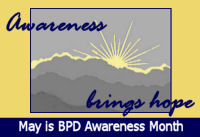
I was even more pleased, however, with the second relevant event that I learned of last week. I found out that on April 1, 2008, the U.S. House of Representatives voted 414-0 to pass the Resolution, H. Res. 1005 [PDF], co-sponsored by Rep. Thomas Davis (R-VA) and Rep. Chris Van Hollen (D-MD), designating May as Borderline Personality Disorder Awareness Month. While I realize that such designations happen commonly and are often formalities, I’m still hopeful that many of us will use this month to raise awareness of BPD, how it truly presents, and its impact.The website of the National Education Alliance for Borderline Personality Disorder (NEABPD) offers more information about the designation and suggestions and tools to help spread awareness of and publicize the disorder during this month.
Education, Appreciation and Publicity: Making the Most of Borderline Personality Disorder Awareness Month
Here are some of my suggestions on what you can do this month, and ongoingly, to better understand and help heal this growing epidemic in our society, which, given the disorder’s prevalence, is likely at some point to touch each of our lives.
- Educate yourself, your friends and your family about the disorder so that you can recognize it if it is or if it becomes a part of your lives. I offer several resources on this website where you can begin learning about the disorder, and where I link to many other resources, as well. These resources on my site include:
-
- My Borderline Personality Disorder bookstore section which includes books like the following:


- My Borderline Personality Disorder bookstore section which includes books like the following:
As you read more of the resources on my site and to which I link, you may experience the “light bulb effect“, which can save you a tremendous amount of confusion and grief if you or someone you care about has BPD.
Also, as a result of recent events refocusing me on the issue and in conjunction with BPD Awareness Month, I may try to write a bit more about various aspects of the disorder in my essays section. I’ve written a short introduction to a new collection of Essays on Borderline Personality Disorder and will add essays at that spot as I write them (so check back there every so often.)
-
- If you appreciate Congress’ measure bringing attention to this important condition, call or write to your Congressperson or to Rep. Thomas Davis and/or Rep. Chris Van Hollen and express your support for greater publicity and research regarding Borderline Personality Disorder.
- If you feel strongly and want to take a more active role, use the posters, flyers, handouts, press releases and other tools offered at the NEABPD web page to spread the word about BPD.
Compassion and Hope for Healing
Finally, I want to make clear that when I speak and write about Borderline Personality Disorder, I do so with great compassion for all of those that it effects – those who themselves have BPD, Nons and anyone else affected by it. For people in any of those positions, the disorder is nothing short of a tragedy that stems from and perpetuates a cycle of deep wounding and pain. I still care deeply for those who have been in my life that suffer from BPD, including those that I have eventually become unable to maintain contact with. Unfortunately, the need to impose healthy boundaries is primary when faced with a relationship in which BPD is involved and, in some cases, the boundary must be quite rigid.
Nonetheless, it remains my greatest hope that someday those boundaries become less necessary and that those relationships could again flourish and become sources of responsible mutual healing rather than pain and dysfunction. Perhaps with greater awareness, publicity and recognition of BPD, combined with improved treatments and motivation for those affected to seek treatment, more of those painful rifts will one day be healed.
 Trackback Address for This Post
Related Posts
- Publicizing The Threat of Personality Disorders Among Those in Positions of Power
- Choosing Intimate Partners: To Repeat or Not to Repeat?
- Announcing My Latest Project: New Website Dedicated to Promoting Wide Range of News and Information Related to the “Science of Evil”
- Announcing the SystemsThinker.com Newsletter (& What I Learned While Creating It)
Tags: borderline-personality-disorder, culture, denial, epidemic, fear-of-abandonment, i-hate-you-dont-leave-me, imago, james-f-masterson, jerold-j-kreisman, narcissistic-personality-disorder, non-borderline, personality-disorders, projection, psychology, public-health, relationships, u.s.-congress, ugly-betty
Included in: Carnival of Family Life - May 12th Edition, Total Mind and Body Fitness Blog Carnival 49, Carnival of Healing #137, Health Wonk Review - May 15, 2008, Brain Blogging, Thirty-Third Edition
May 5th, 2008 at 11:23 pm
Excellent, excellent post! You really touched on a lot of the elements of BPD that make it difficult to diagnose and to treat. I am just in awe at how many people are affected by it yet the amount of attention and recognition its given just doesn’t measure up. Hopefully having this BPD Awareness Month will help.
I’ll have to come back and read this later when my mind isn’t so foggy and I can better organize my thoughts. ;)
May 5th, 2008 at 11:37 pm
Thanks for this post and for your comment on my blog. Your work and effort is greatly appreciated! Keep up the good work. BTW, my opinion of Stop Walking on Eggshell (i.e. SWOE) is pretty dim. I hope to provide a better resource soon and would appreciate your support in that effort. Take good care,
Bon
May 6th, 2008 at 12:56 am
Wow, thanks for the info about the Ugly Betty episode. I had no idea as i am not a watcher of the show. But I am definetly going to check out the episode. If you find other shows that mention or feature a character with BPD, do not hesistate to let me know!!! I am a “closet” borderline, but that may change in the future.
Dont forget to check out the BPD bracelets link on my page, its another way of promoting BPD Awareness. And there is another link there that shows of other ways, like flyers and such.
Have a nice day!
May 6th, 2008 at 6:18 am
Superb post! Thank you!
May 11th, 2008 at 1:12 pm
Thanks for participating in this week’s Carnival of Family Life, hosted at Write from Karen! Be sure to stop by on Monday, May 12, 2008, and peruse the other wonderful articles included in this week’s edition!
May 12th, 2008 at 10:10 am
Total Mind and Body Fitness Blog Carnival 49…
Monday is Blog Carnivals Day. A Blog Carnival is basically a collection of articles or blog posts, all relating to a similar subject, that are gathered together for your viewing pleasure. You can quickly and conveniently see a list of Article Titles a…
May 15th, 2008 at 1:42 am
[…] Systems Thinker reminds us that May is Borderline Personality Disorder Awareness Month. […]
May 17th, 2008 at 10:37 am
[…] reports on Borderline Personality Disorder Awareness Month: Discussing, Understanding & Publicizing an Und…: I have gone so far as to say that Borderline, along with perhaps Narcissistic Personality Disorder […]
May 17th, 2008 at 12:35 pm
Brain Blogging, Thirty-Third Edition…
Welcome to the thirty-third edition of Brain Blogging. In this round, we cover a range of topics from personality disorders, crying men, mastering self-control, total body detoxification, and working out your brain to Martian invasions.
If you were lef…
May 22nd, 2008 at 8:31 pm
[…] Discussing, Understanding & Publicizing an Under-Recognized Epidemic […]
May 28th, 2008 at 10:34 pm
Hi there, I was just watching Eternal Sunshine of the Spotless Mind on the netflix viewer. I was reminded of the first time I saw it at the beginning of my last relationship with a woman who had, it turned out, BPD. I too had that familiar “light bulb” moment and finally got out of the relationship after 3 years.
So anyway, I was thinking about how “poignant” the film felt to both me and my ex when we first saw it. Yet watching it again, with what I know now, I was instantly struck with the lightbulb again– Clementine is BPD! She is impulsive, quick to endear and shows an exterior social side that belies the “inner” self she starts to demonstrate only to show in her private relationship. Outbursts of anger, fights on the street over minor things… Suddenly, the film took on a completely new meaning to me; the parallels to my own experience were close.
I paused the movie then and googled “clementine eternal sunshine borderline personality” and your site came up. I enjoyed reading your thoughts about BPD. Having been through a relationship with someone who has BPD it’s really good to see one isn’t alone in such experiences. So thank you for this. I’ll check out that Ugly Betty episode now. Also, interesting site!
By the way, have you looked into some of the research linking BPD with a sort of limbic system epilepsy? Among BPD sufferers, there is a high rate of comorbidity with seizure disorders. I personally witnessed some mild seizure like behavior in my ex when she got very upset a few times. Nothing definitive out there, but a Dr. Heller claims to have treated BPD successfully with tegretol. Of course it might just be sedating them! However, when I read about this organic model for BPD, it helped me to put my ex’s behavior in perspective, and to dispel some of the resentment I had continued to hold against her for her behavior towards me.
regards,
Ted
May 29th, 2008 at 1:33 am
Ted,
I’m glad to hear you had the light bulb moment and gained a lot of insight. It really is amazing watching a movie like Eternal Sunshine once you start to see the parallels. Interestingly, I had that film recommended strongly to me by someone who also themselves had BPD patterns and found it so poignant and knew, intuitively, that I would also find it powerful due to my experiences, though they wouldn’t have been able to put a finger on why. It ended up being one of my favorite movies. Very glad Charlie Kaufman got the well-deserved Oscar for writing it.
Thanks for the kudos on the site and I hope you found a lot of helpful information and resources in this piece and especially on my main Borderline Personality Disorder page. You’re far from alone. I highly recommend some of the resources for Nons listed at the bottom of that main page.
I have read some about the biological mechanisms in the limbic system in BPD. I am quite open to the idea that those play a role, though I don’t know if they are the origin or just the mediator. I haven’t seen a lot of evidence that BPD can be treated just biologically, but I certainly have seen many that take into account the biological aspect in understanding and treating it.
Nonetheless, I agree with you that understanding that those with BPD really have some deeper basic mechanisms going on in them that underlie these behaviors can help us be more compassionate even as we set boundaries and try to protect ourselves, as well.
Thanks for the comments, Ted.
June 28th, 2008 at 7:11 am
Hi Howard… I just came across your site this morning, and I’m impressed with your writing about borderline personality disorder.
I’m also amazed at how widespread these disorders (bpd along with narcissistic personality disorder) are and how many people have not heard of them, or have heard of them only in a limited context.
The pain, the emotional devastation, the financial cost to both those who suffer from bpd as well as to those who are involved with someone with this disorder are quite extreme… but those who suffer from this disorder are often not diagnosed accurately. One of the reasons for this is the nature of mental health treatment…. If and when a person with bpd shows up on a therapist’s doorstep, the person with bpd will rarely present an accurate picture of their own behaviors and is often very good at presenting themselves as the victims of abuse by their partner, parent, or even children. Therapists are often not open to interviewing loved ones and they miss the bpd.
Also I think the comorbidity of bpd with other disorders, including NPD, ADD, bipolar, OCD, etc., tends to mask the BPD. Though NPD and BPD seem like very different disorders, they are actually similar and many people display traits of both or “change forms” as they go through life. BPD is often associated with self-destructive tendencies, and these may be absent in someone with BPD/NPD… until a very stressful time in the person’s life in which case the BPD self-destructive tendencies may come bubbling to the surface.
In his comments above, Ted mentions Dr. Heller who does believe that people with bpd can be treated medically. In our forums at http://www.bpdfamily.com , we have one active poster who has described her experience with Dr. Heller. This woman also claims that several other neighbors and relatives have been treated successfully by him. Dr. Heller’s website is http://www.biologicalunhappiness.com . On the other hand, we have many members with loved ones who have been treated with a wide variety of medications for years who are still struggling.
The emotional regulation problems of bpd apparently can be helped with meds, but the most intractable problem seems to be a “trait” that isn’t even discussed in the DSM, and that is an inability of the person with bpd to see themselves, a lack of insight, a pervasive pattern of blaming others and presenting themselves as a victim. Projecting is very common, and, as discussed above, many people with bpd simply don’t accurately portray their situation to mental health providers who might be able to help them.
Howard, what’s happened with you since these blog entries from a few weeks back? You mentioned that you might have to leave the person you were involved with. The decision to stay with someone, particularly if they are open to treatment, or to leave is never easy. We have separate forums for those who are staying and those who are leaving, also for those who are dealing with the issues of divorcing or sharing children, difficult situations often rendered next to impossible by the presence of bpd.
Oh yes, here’s a YouTube video on bpd: http://www.bpdfamily.com/bpdresources/nk_a102.htm
Your blog is very interesting and informative.. Thanks and Good luck!
June 30th, 2008 at 10:29 am
Jo,
Thanks for your comments. The gap between the prevalence and impact vs. the recognition of BPD and NPD is so great that it points to a blind spot in the entire culture. And as you say, so true that these are slippery conditions because by their very nature they involve a lot of misleading and misrepresentation. It takes a very shrewd therapist to spot them in many cases. And as you point out, the way the disorders can wax and wane and present so differently in different situations only makes it trickier. All of these factors make them very challenging conditions to diagnose accurately and at the same time very crucial to diagnose accurately.
The lack of insight and the projection that are mainstays of these disorders are a big part of what make them so difficult to treat and also so fascinating. Any disorder can come with a lack of insight or projection but here you have disorders that center around those very things. It’s all part of why the disorders fascinate me so much. They really embody the catch-22 nature of so many of the dysfunctional aspects of the culture.
Thanks for the comments and the resources.
July 5th, 2008 at 10:32 am
Hello:
I’ve enjoyed reading your blog posts about BPD. I especially liked this:
>>
I wanted to let you know that I have a new book coming out in October of 2008 called “The Essential Family Guide to Borderline Personality Disorder: New Tips and Techniques to Stop Walking on Eggshells. My publisher (a new one) Hazelden, is planning to do a national publicity campaign. This is new–my first book (Stop Walking on Eggshells and the accompanying workbook) didn’t get any publicity.This offers a great opportunity to raise awareness. I can stop back here and let you know when the books are out (not sure when in October).
I think that the greatest challenge in raising awareness of BPD is its complexity. I have been writing books and moderating Welcome to Oz (my support groups) for 12 years and I am STILL challenged to come up with a short way to respond what people ask me what BPD is. I am going to be on a national TV program next year, and coming up with a one minute explanation is my next challange.
I also wated to make a comment on what “dialectical” means in DBT. Marsha Linehan, the founder, says it has to do with the seeming opposite assertion of “You’re perfect–now change.” The challenge is getting people to accept themselves as they are but still focus on changes they need to meet.
I very much agree with the Borderline Society concept in “I Hate You–Don’t Leave Me.” I mostly see society splitting, seeing people and situations in black and white, and encouraging impulsivity.
Thanks for the discussion. I hope to take part in it again.
Randi Kreger
July 5th, 2008 at 3:33 pm
Thanks Randi. Good to hear from you. I think it got cut off which part you were referring to that you especially liked. Definitely let us know when the new book is coming and I’ll keep an eye out for the publicity. It would be great to see the issue discussed widely and publicly.
When asked what BPD is, I usually focus on the early invalidating experiences which lead to a highly fragmented identity (the Internal Family Systems model gives me the best framework within which to explain this). To me the rest of the symptoms stem from there. The fear of abandonment and fear of engulfment, the projection, the impulsiveness and self-mutilation – all of it seems to be an attempt to cope with the pain of that lack of solid identity and integration in the personality. I think the hard part is that the disorder isn’t really driven by the symptoms, but the symptoms reflect a deeper structural issue that falls in the culture’s blind spot. Of course this is really true with many disorders, even basic ones like depression, where we tend to focus on superficial symptoms instead of the often incredibly different underlying causes.
Dialectical is a big concept for me. I’ve been writing more about it in some new pages I’m preparing. I’ve always seen it as simply the process of transcending dichotomies to find third-hand solutions. The particular dichotomy Linehan focuses in on is certainly a core one.
Thanks for your thoughts and keep us posted, Randi!
July 20th, 2008 at 3:06 am
[…] Ditkoff presents Borderline Personality Disorder Awareness Month: Discussing, Understanding & Publicizing an Unde… posted at SystemsThinker.com Blog. According to Howard, “Borderline Personality Disorder is […]
August 10th, 2008 at 12:20 pm
Well your way to compassionate for me in your article concerning people with BPD. As far as my personal opinion Youthanization is the only form of treatment left for people with this disorder. They wreck and ruin and damage the lives of everyone around them even there own children, and then blame somebody else for it. Please any BPD ‘s reading this right now, do your family and friends and those closest to you a favor kill yourself before you kill them. I know it may seem cold minded but trust me it’s better for those people knowing your dead ,and have moved on then it is to tolerate constant accusations and abuse by your hands. Some where in the warped mind of a BPD, you know your at fault and are defective thats why it’s time for you to check out, it’s called natural selection. Our problem in the medical world is we are constantly trying to help losing causes, when we need to think about how to eradicate them.
Will
August 23rd, 2008 at 7:54 am
“…a “trait” that isn’t even discussed in the DSM, and that is an inability of the person with bpd to see themselves, a lack of insight, a pervasive pattern of blaming others and presenting themselves as a victim”
Many of those with BPD have been terribly victimized – and often by those that should have supported them most – family, medical services, social services…
That said, this mental illness is no different from all other serious mental illnesses – a small percentage do have insight into their behavior, a much larger percentage struggles with a pervasive image of badness, pathological guilt and shame precisely because they do not understand why they go off the deep end from time to time and why they cannot be like most people, they are even ashamed of their suffering, thinking that it must be because they are so self centered. Then there are those who do not have a clue, who can not see the suffering they inflict, perhaps because their own is so great or perhaps because they have confused projection with empathy, which even “normal” people will do under stress.
Invalidating environments are often traumatic ones or interpersonal trauma arrives because these environments do not protect their young. But there is probably an innate hypersensitivity and concern with the feelings of others that in a caring and helpful environment could lead to high emotional intelligence and gifted empathic understanding. Many of those who end up with BPD hid all their traumas, griefs and worries from their parents throughout their children so as not to burden others with their problems. So many parents who think that their child with BPD had a “happy childhood” do not have a clue as to how terribly unhappy their child was.
DBT does help bring the anxiety level down, but it fails to address the deep existential pain that smolders at the core of this disorder. Through DBT those with BPD learn not to bother anyone anymore – but most are still severely handicapped by dysthymia, insomnia, etc. We need to recognize, address, and find ways to treat this unbelievably painful dysphoria that waxes and wanes throughout the life span if we really want to help those with BPD.
I personally think that this dx is absolutely overused and much abused. We rapidly think borderline, laying it on right and life to all the difficult or disagreeable or seemingly dramatic people who cross our path. The truth is that the DSM with its absurd “objectivity” fails miserably to describe one kind of person and misses the core symptom of this illness – an emotional pain so overwhelming that one’s self – and one’s personality, are caught and submerged in the deluge.
Ours is a superficial cultural that encourages reductive, simplistic thinking and aggressive behavior. It is a culture that teaches one that it is best to strike out before one is stricken, that visibleness is the only way to fame and fortune. That encourages behaviors that may seem “borderline” – but the difference is enormous between many people who adopt these social strategies as a way of life and those who as hard as they may try, as much as they might hate themselves for their reactions, cannot bring their feelings under control in moments of emotional stress. This is a “personality disorder” that is not syntonic in nature and that alone is enough to suspect it as a problem of personality. One the contrary the erratic behavior of someone with BPD in times of crisis is about losing one’s personality, one’s SELF. It is only a question of time before this serious mental illness finds its way to Axis I. The label “Borderline Personality Disorder” will one day be seen as terribly inaccurate, moralizing and inept, if not totally forgotten.
September 4th, 2008 at 6:49 am
Phin,
Thanks for your eloquent thoughts. You really capture the inner pain that those suffering with BPD experience. No doubt many have been victimized terribly and, as a result, find themselves caught up in the cycle of abuse. I agree that when it comes to insight, there is a spectrum among those with BPD. I agree that many who end up with BPD are probably those who were most sensitive to invalidation early on and who, raised in a healthier environment, may have become even more truly empathetic and compassionate than others without the disorder. I agree that the DSM, by focusing too much on outer signs rather than inner dynamics leads to tons of misdiagnosis.
However, I also think that the disorder is actually under-diagnosed at the same time that it is misdiagnosed in many. We’re both labeling the wrong people BPD, while failing to recognize BPD in many others who are diagnosed as Bipolar, for example, or probably more often not diagnosed at all since they don’t seek treatment.
You are correct, in my view, that the key to the disorder is the loss of self. And classifying disorders based on this kind of psychodynamic focus challenges the DSM’s entire model of labeling, as well as the blind spots of our culture. We desperately need a psychology based on mechanism rather than symptoms.
September 9th, 2008 at 11:46 am
[…] doesn’t have anything to do with the commercial again, other than that and a post over at SystemsThinker.com has me thinking about what actually qualifies as epidemic. His really excellent discussion of […]
September 9th, 2008 at 11:50 am
Hi Howard,
Great post. I found it really interesting. And one word of it sparked a bit of a tangent over at my blog. It’s not quite to do with BPD but it was inspired by this post. Hope you’ll come check it out.
September 10th, 2008 at 6:08 am
Katie,
Thanks for the comment and I’m glad the post sparked some interest. I think the issue here is less the definition of epidemic than the definition of contagious. Dictionary.com shows the definition of epidemic to simply include “spreading from person to person in a locality.” It doesn’t say spreading due to a bacteria or virus. Ideas spread in these epidemic ways too. I think this was the main point of The Tipping Point which looked at the similar factors involved in the spread of everything from a biological disease to a fad. As a Systems Thinker, those types of related patterns are what interest me. And so in terms of what can be classified an epidemic, I don’t think it’s at all limited to those things spread by biological means.
I think more confusion comes in regarding the term contagious. Many people think of contagious only as it relates to biological transmission. And the dictionary shows why there is this confusion. The medical definition does seem to focus on biological transmission due to physical contact. But the laymen’s definition doesn’t necessarily.
Emotional patterns like BPD are certainly spread from person to person. The mechanism of that is debated. There may be a mixture of genetic and environmental components. But the spreading nature of it is a great part of what makes it so dangerous. Many link BPD to childhood invalidation, which is more common with a parent that lacks empathy or ability to mirror the child themselves due to emotional impairment. The child then develops a similar inability to empathize and fails to develop a strong identity without the mirroring. They then act in ways that can trigger similar patterns in future partners and children. Those who work with Nons (people without BPD who are in relationship with someone with BPD) use the term “fleas” to describe the way the BPD traits seem to jump so that the Non begins to start feeling and acting like the partner with BPD.
When looking up the Tipping Point just now I saw a book titled Emotional Contagion. And in a way that term sums up what is at the core of the issue. Emotional patterns and psychological structures are certainly spread among a population. The mechanism of how that happens is something of great fascination to me and which I talk about throughout my site. A lot of the unhealthy patterns and structures are a result of various types of emotional trauma and I think and write a lot about how that trauma specifically affects us emotionally to lead to outcomes that we can call things like BPD. And yet, this phenonenon is a huge blind spot in our culture. Biologically infectious diseases that affect 3 or 4 or 5% of the population rightly begin to attract great public health attention and resources. But emotionally “infectious” diseases that affect that many or more often receive little attention and are not even known to most people in the population even though they are wreaking havoc in terms of suffering caused.
It’s easier to see the direct devastation of something like AIDS because we see a patient physically deteriorate in front of us. So it’s more obvious to people why, when it becomes relatively widespread, great educational, treatment and prevention campaigns are called for. But conditions like BPD, NPD, and sociopathy do their work more insidiously and can undermine an entire culture, leading to unsustainability on a massive scale. Yet it can all fly under the radar in a way a disease like AIDS doesn’t (though it’s a testament to the size of our blind spot that even it did for a long time and continues to in some places). And this is what I mean by the “emotional blind spot” in our culture. Since emotional conditions work more insidiously and invisibly, our materialistic culture doesn’t notice them until after they emerge in some larger material way. And then when they do, even then the link often isn’t made to their role in that outcome.
This is why I was excited to see Congress recognize BPD Awareness Month. I think it’s utterly crucial to the health and survival of this culture that certain emotional conditions, especially those that impair empathy, receive the widespread public health focus that any biological illness of the same scale and impact would receive. This was a small step in the right direction as a model for not only recognizing BPD, but recognizing these less materially visible, but extremely impacting, psychological patterns and arrangements that are spreading in our society.
September 11th, 2008 at 2:53 pm
[…] what Howard Ditkoff of SystemsThinker has pointed out to me in our here and there conversation about BPD and the word epidemic is that […]
September 11th, 2008 at 2:58 pm
[…] what Howard Ditkoff of SystemsThinker has pointed out to me in our here and there conversation about BPD and the word epidemic is that […]
March 15th, 2009 at 10:39 am
[…] Borderline Personality Disorder Awareness Month: Discussing, Understanding & Publicizing an Unde… […]
March 28th, 2009 at 12:18 am
Finally.. this describes the relationship I just ended with a 911 call because I was hit by my partner then she bit me. I kept trying because when things were good they were great but then it would just go horrible and for no reason! I have felt so emotionally beat up not to mention the physical kept getting worse. From pushing, shoving, biting, throwing stuff at me and then finally the punch. I am so sad because I had such true love but when that switch came it was just becoming disgust and hate. My compassion ran out and this person never wanted to accept they had a problem.. it was all me. Thanks for the insight. Are there support groups for people like me?
May 10th, 2009 at 10:37 am
Pamela,
There are certainly support groups for people like you. The key will be figuring out over time precisely what issue you’ve been facing. Was your partner BPD, antisocial or narcissistic? Are you dealing with codependence? For these and other issues there are many forums online and off that can offer you a chance to grow and heal with people who have been there too.
I have links to some such places for those who have been involved with BPD partners on my Borderline Personality Disorder page. You may want to look into other groups like Codependents Anonymous as well. I think if you start exploring in places like that, you’ll learn more and perhaps focus in on just where you belong, which groups may be the right ones for you and therapists and others who can help.
You may also find useful information in some of the books listed in the Psychology section of my bookstore.
Thanks for writing.
May 3rd, 2010 at 3:39 am
does anyone know where to get the bpd awareness silocin bracelets so an organisation here in new zealand can sell the to raise money… etc